In the highly volatile cryptocurrency market, simply having a trading strategy is not enough. Professional traders and investors always pay close attention to an important metric alongside their strategy: the Risk-to-Reward Ratio. This ratio helps traders gain a clear picture of potential profit versus possible loss before entering any trade.
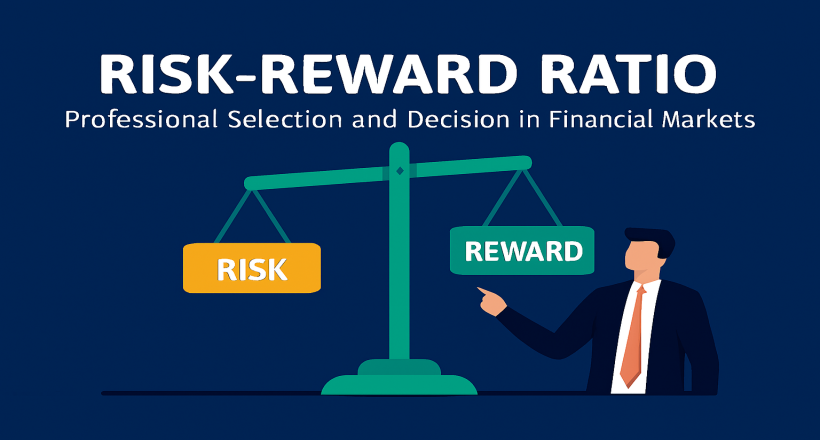
In essence, the risk-to-reward ratio shows how much profit a trader expects in exchange for accepting a certain level of risk. This concept, often abbreviated as R/R, is one of the key tools for evaluating the quality of trades in the cryptocurrency market.
When the risk-to-reward ratio is calculated correctly, traders can make informed decisions about whether entering a trade is logical or not. That is why professional traders always consider Risk/Reward as one of the core components of their trading systems.
Paying attention to this ratio plays a crucial role in capital management in cryptocurrency trading. It helps traders avoid entering high-risk and irrational positions. Proper use of the risk-to-reward ratio aids in controlling emotions, reducing heavy losses, and increasing long-term profitability.
In this article, we aim to explore the concept of risk and reward in more detail and examine its application in cryptocurrency trading. Stay with us.
What Is the Risk-to-Reward Ratio?
Professional traders always strive to maximize profits while minimizing losses. To achieve this goal, they use a tool known as the risk-to-reward ratio. This ratio indicates how reasonable a trade is in terms of potential profit versus possible loss.
Whether you are a long-term investor, a scalper, or a swing trader, understanding potential gains and possible losses is essential in every trading style. The Risk/Reward ratio allows traders to evaluate different scenarios before executing a trade and make decisions accordingly.
Before entering a trade, you must first determine how much loss you are willing to accept in order to achieve a certain level of profit. This mindset forms the foundation of professional thinking in financial markets and prevents emotional and irrational decision-making.
How to Calculate the Risk-to-Reward Ratio in Cryptocurrency Trading
To calculate the risk-to-reward ratio in the cryptocurrency market, you must first determine two key components of any trade: Take Profit and Stop Loss. These two levels define the framework for potential profit and loss, and without them, calculating the Risk/Reward ratio is not possible.
Once these levels are set, simply divide the potential loss by the expected profit. The result of this calculation represents the risk-to-reward ratio of your trade, which should be evaluated and accepted within your trading plan before entering the position.
In this calculation, the take-profit level refers to the maximum return you expect the price to reach, while the stop-loss level represents the maximum loss you are willing to tolerate. The smaller the resulting number, the more attractive the trade is in terms of profit relative to risk. Conversely, a higher number indicates increased risk and reduced trade justification.
Practical Example of Calculating Risk/Reward
To better understand this concept, let’s consider a simple example. Suppose a trader plans to enter a cryptocurrency trade with a long-term perspective. Based on technical analysis, they set a 15% take profit and a 5% stop loss.
In this case, the risk-to-reward ratio is calculated as follows:
5 ÷ 15 = 0.33
This value is commonly expressed as 1:3, meaning that for every one unit of risk the trader accepts, they expect to gain three units of profit. In simpler terms, if there is a potential loss of one dollar in this trade, the potential profit is estimated to be around three dollars.
How to Improve the Risk-to-Reward Ratio of a Trading Portfolio
One of the most important ways to reduce the risk-to-reward ratio in cryptocurrency trading is to place the stop loss at a logical and relatively close distance to the entry point. However, this should never be done without proper analysis or based purely on guesswork.
Tightening the stop loss is only reasonable when it is done after a careful examination of the price chart, key support levels, and overall market structure. Conscious use of technical analysis helps reduce risk while also preventing premature and irrational exits from trades.
What Does the Reward-to-Risk Ratio Mean?
The reward-to-risk ratio can be considered the opposite of the risk-to-reward ratio. In this approach, instead of focusing on potential loss, the expected profit is evaluated relative to the possible risk. To calculate this ratio, simply divide the take-profit level by the stop-loss level.
For example, if a trade has a 15% take profit and a 5% stop loss, dividing these two values results in a reward-to-risk ratio of 3. This number indicates how many times the potential profit exceeds the possible loss if the trade is successful. In general, the larger this ratio is, the more attractive and valuable the trade becomes in terms of profitability.
The Relationship Between Capital Management and Risk/Reward
Capital management is one of the core pillars of success in financial markets. Traders who master capital management principles not only control the risk of their trades but also achieve more sustainable profitability in the long run. This skill significantly reduces the likelihood of heavy losses and helps extract the maximum possible return from trades.
To achieve this, an effective trading strategy must be combined with solid capital management knowledge. Decisions such as choosing the right time to exit a trade or implementing strategies like partial profit-taking (cash-out strategies) are examples of professional approaches along this path.
Conclusion
As discussed in this article, the risk-to-reward ratio is one of the most fundamental principles of trading in financial markets. Experience has shown that many individuals who suffer heavy losses enter trades without paying attention to this ratio. Ignoring Risk/Reward can expose a trader’s capital to serious risks.
To consistently keep trading risk under control, it is essential to continuously strengthen your technical analysis and fundamental analysis skills. The better your understanding of market conditions and price behavior, the easier it will be to identify logical, lower-risk trading opportunities.